Name Change After Marriage in India: The Complete Guide, Step by Step with Process, Time, Cost and FAQ
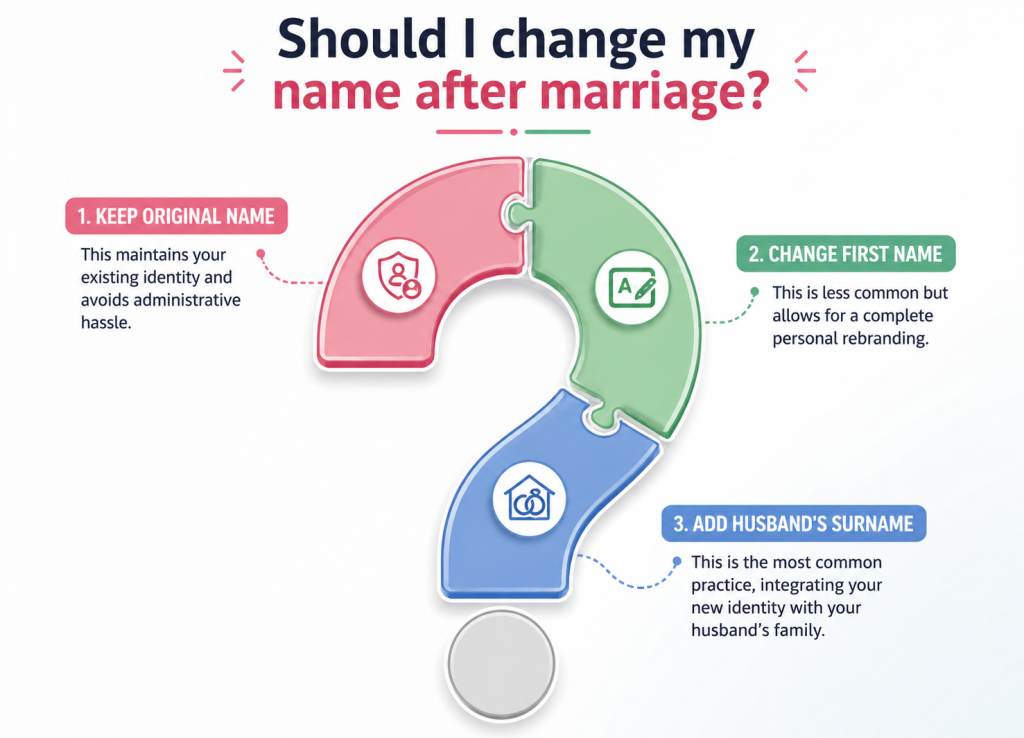
Changing your name after marriage in India is not mandatory. You can keep your maiden name, adopt your spouse’s surname, combine both names, or make no change at all. The choice is entirely yours, and India law does not require it and force you to do same in India or in our country.

If you do decide to change your name, a Gazette notification is usually not required for a simple surname change after marriage. Your marriage certificate is normally enough to update Aadhaar, PAN, your passport, and most other records. A Gazette notification becomes important mainly when you are making a bigger change, such as changing your first name, or when a specific document or employer insists on it.
This guide walks through the complete process: what is mandatory and what is optional, every document you may need to update, the exact steps for each one, realistic costs and timelines, and answers to more than 25 common questions.
What Is Name Change After Marriage?
Quick answer: Name change after marriage is the process of updating your legal name, usually your surname, across your identity documents and official records after your wedding. In India, this is a personal choice, not a legal requirement. It typically involves updating documents like Aadhaar, PAN, your passport, voter ID, driving licence, and bank accounts to reflect your new name, using your marriage certificate as the primary supporting document.
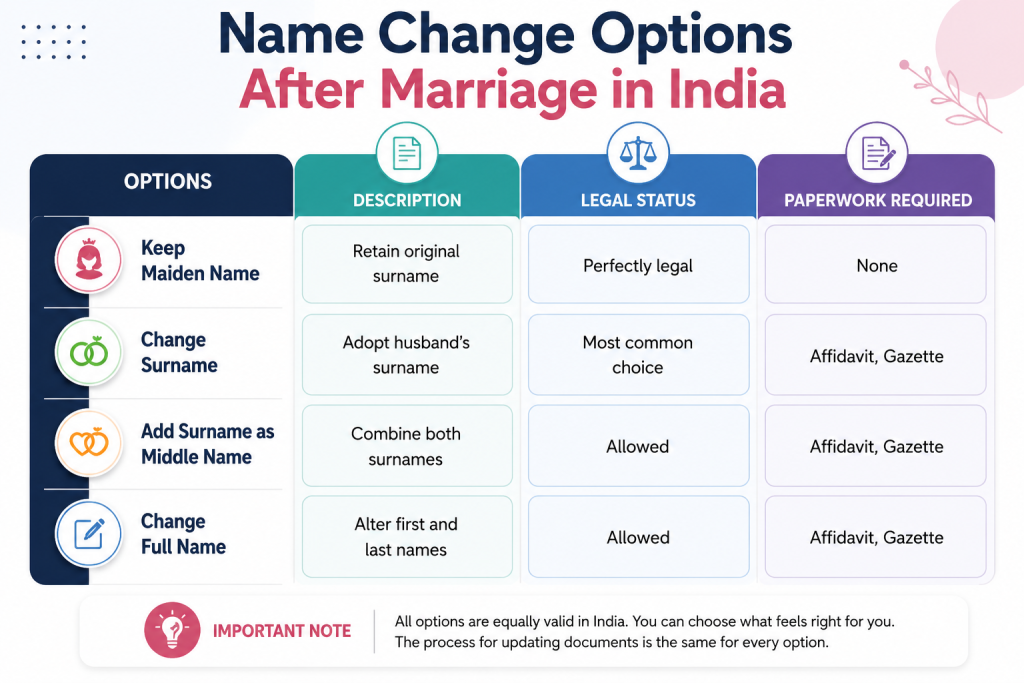
In India, a name change after marriage commonly takes one of four forms:
- Replacing your maiden surname with your spouse’s surname
- Adding your spouse’s surname to your existing name, while keeping your own surname too
- Keeping your name exactly as it is, with no change at all
- Adding your spouse’s first name as a middle name (less common, but seen in some communities)
None of these require a court order. A marriage certificate, in most cases, is the only document you need to set the process in motion.
Is It Mandatory to Change Your Name After Marriage in India?
Quick answer: No. There is no law that requires a woman, or a man, to change their name after marriage in India or in country. The Hindu Marriage Act 1955, the Special Marriage Act 1954, and the various state marriage registration laws govern how a marriage is registered, but none of them mandate a name change as a condition of marriage or its registration.
This is one of the most common misconceptions people have in India or in our country. Many women assume that updating their surname is a legal formality tied to marriage registration. It is not. Your Registrar of Marriages will register your marriage and issue your marriage certificate regardless of whether you intend to change your name.
What is true is that practical consistency matters. If you do decide to change your name, every document that carries your old name, from your Aadhaar card to your bank passbook, will eventually need to reflect the new one if you want to avoid mismatches during verification, travel, or financial transactions.
Can You Keep Your Maiden Name After Marriage in India or in our Country?
Quick answer: Yes, completely and without restriction. Keeping your maiden name after marriage is fully legal in India and does not affect your marriage’s validity, your spouse’s legal rights, or your own rights as a married person. Many women, particularly in professional and urban settings, choose to keep their maiden name for their entire lives.
If you keep your maiden name, you do not need to update any document. Your existing Aadhaar, PAN, passport, and other records remain valid exactly as they are. The only situations where this can create friction are when a specific institution, such as a foreign visa authority or a particular bank, requests documentation linking your maiden name to your marital status. In these cases, your marriage certificate itself, which lists both names, usually resolves the issue without needing a formal name change.
Can You Use Both Your Maiden Name and Married Name in India or in Our Country?
Quick answer: Yes. There is no legal restriction on using a combined name in India, such as “Priya Sharma Mehta” or “Priya Sharma-Mehta,” after marriage. This is sometimes called a hyphenated or combined name, and Indian government departments generally accept it as long as it is applied consistently across your documents.
A few practical points to know if you choose this route:
- Decide on the exact format you want, including spacing and any hyphen, before you start updating documents, since inconsistent formatting across Aadhaar, PAN, and your passport can cause verification issues later.
- Some forms have character limits for the name field, which can force you to abbreviate a combined name on certain documents even if you intended to use the full version.
- Banks and financial institutions are generally comfortable with combined names, but it is worth confirming the exact format your bank will accept before submitting your KYC update.
Can a Husband Take His Wife’s Surname in India or in our Country?
Quick answer: Yes. There is no legal restriction preventing a husband from adopting his wife’s surname, or both partners adopting a combined surname in India or in our country. The process is identical and gender-neutral — the same marriage-certificate route applies regardless of which spouse changes their name.
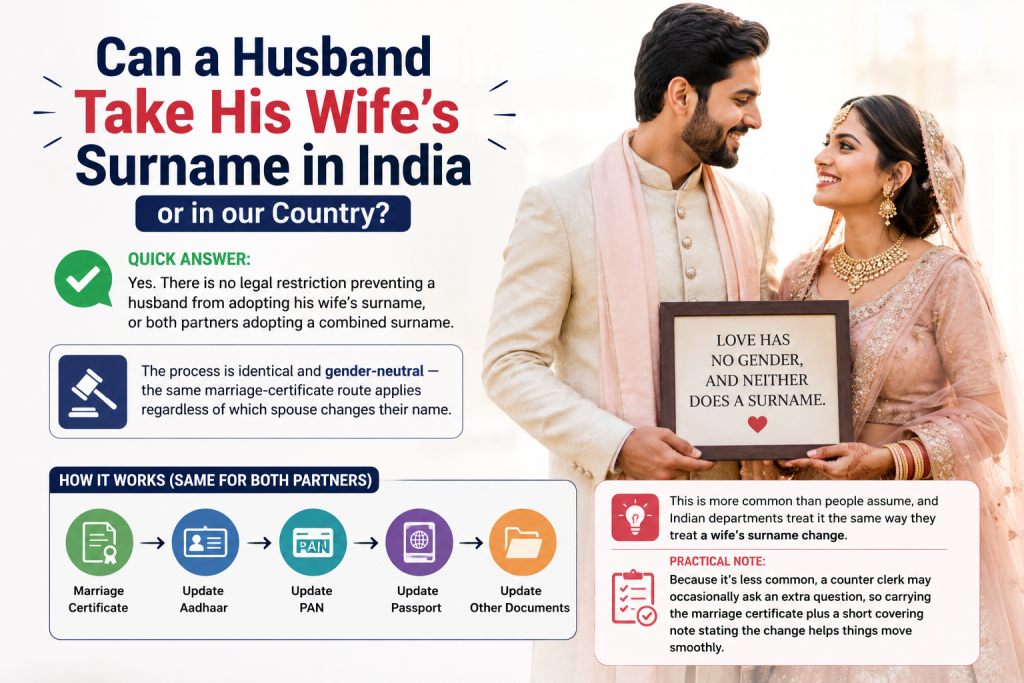
This is more common than people assume, and Indian departments treat it the same way they treat a wife’s surname change. The husband updates Aadhaar first, then PAN, passport, and the rest, using the marriage certificate as proof. The only practical note: because it’s less common, a counter clerk may occasionally ask an extra question, so carrying the marriage certificate plus a short covering note stating the change helps things move smoothly.
Benefits and Drawbacks of Changing Your Name After Marriage in India
Quick answer: In India and in our country, The main benefit of changing your name after marriage is consistency; it can simplify joint financial applications, travel, and day-to-day verification once every document matches. The main drawback is the administrative effort; updating ten or more documents takes time, costs a modest amount, and requires careful sequencing to avoid mismatches along the way.
| Benefits | Drawbacks |
| Consistent identity across all documents, useful for joint loans, property, and bank accounts | Updating every document takes weeks to a few months in total |
| Simpler for children’s school admission and family-linked paperwork | Involves fees across multiple departments, which add up |
| Some people feel it reflects a meaningful personal or cultural choice | Risk of temporary mismatches while updates are in progress |
| Easier verification for visa applications that ask about marital name changes | Professional records, degrees, and prior published work remain under the old name unless separately corrected |
| Reduces confusion in future correspondence with banks, insurers, and departments | Reverting later is possible but requires repeating much of the same process |
There is no right answer here. Many women change their name immediately after marriage, many never change it at all, and a growing number choose a combined name as a middle ground. All three are equally valid and equally legal.
Documents Required for Name Change After Marriage in India
Quick answer: In India and in our country, The core document you need for a marriage-based name change is your marriage certificate, issued by the Registrar of Marriages. For most identity documents, this single document is sufficient. A Gazette notification, affidavit, and newspaper advertisement are only needed for more significant name changes, such as changing your first name, or when a specific document update requires them.
| Document Needed | When You Need It | Where to Get It |
| Marriage Certificate | Almost always — the primary proof for a marriage-based change | Registrar of Marriages, or state online portal |
| Aadhaar (old) | Identity proof when updating other documents | Already in your possession |
| PAN (old) | Identity proof for PAN and bank updates | Already in your possession |
| Passport (old) | For passport reissue and some verifications | Already in your possession |
| Affidavit | Only for first-name/full-name changes, or if an institution asks | Non-judicial stamp paper, notarised |
| Newspaper Ad | Only if pursuing a Gazette notification | Published in one or two newspapers |
| Gazette Notification | Major changes, or once Aadhaar’s update limit is used up | Department of Publication / state Gazette |
| Annexure J | Alternative to a marriage certificate for passport updates | Passport Seva portal |
| Photographs | For most physical document updates | Any photo studio, per specifications |
A useful rule of thumb: if your name change is simply adopting your spouse’s surname, your marriage certificate alone will carry you through almost every document on this list. The affidavit, newspaper ad, and Gazette notification only become necessary for a bigger change in your name’s structure.
Error in Your Marriage Certificate? Fix This First in India
Your marriage certificate is the base proof for the entire process, so check it carefully before you start anything else. If your name, your spouse’s name, the date, or the spelling is printed wrongly on it, get that corrected at the Registrar of Marriages first. A mistake on the certificate will copy itself into every later update and cause repeated rejections. Five minutes of checking now saves weeks later.
Step-by-Step Process to Change Your Name After Marriage in India
Quick answer: The typical sequence is to first obtain your marriage certificate, then update Aadhaar (since most other departments verify against it), followed by PAN, passport, bank accounts, voter ID, driving licence, and finally your employment and educational records. A Gazette notification, if you choose to get one, can be done in parallel but is not required before you start updating most documents.
Obtaining a Marriage Certificate
Your marriage certificate is the foundation of the entire process. In India, marriages can be registered under the Hindu Marriage Act 1955, the Special Marriage Act 1954, or various state-specific compulsory registration laws, depending on your religion, the type of ceremony, and the state. To get it:
- Apply at the office of the Registrar of Marriages in the district where the marriage took place, or where either spouse resides, depending on your state’s rules.
- Submit the required documents — proof of age, proof of residence, marriage invitation card or ceremony photographs, and identity proof of both spouses and witnesses.
- Most states now offer online application through their marriage registration portals, with the certificate issued digitally or available for collection after verification.
- Processing time varies by state, from a few days to a few weeks.
Once issued, request a few certified copies. You will need to submit copies, not your only original, to multiple departments.
The Gazette Process for Name Change After Marriage (All 3 Steps in Detail)
In India and in our country, For a simple surname change after marriage, your marriage certificate is usually enough and you can skip this entirely. But if you’re changing your first name, doing a bigger change than just adopting your spouse’s surname, or you simply want the strongest all-India proof, the gazette is the route. It has three steps, in this exact order: affidavit, newspaper advertisement, then the gazette notification. Here’s each one in full.
Step 1: Prepare and Notarise the Affidavit
The affidavit is your sworn declaration that you’ve married and are changing your name in India. It’s the foundation — every later step copies from it, so accuracy here decides everything.
What it must state:
- Your full maiden name, exactly as it appears on your current ID
- Your new married name, exactly as you want it printed everywhere
- Your spouse’s name, your marriage date, and the place of marriage
- Your full residential address
- A clear line that both names refer to the same person, and the reason (marriage)
How to do it:
- Get non-judicial stamp paper of the value your state requires (commonly ₹10 to ₹100). Many states now issue a digital e-stamp, which is quicker.
- Type the affidavit on the stamp paper in clear, correct English (or your state language), with no spelling slips.
- Sign it before a Notary Public, who stamps and attests it. Some states accept an Executive Magistrate or Oath Commissioner instead.
- Keep a few notarised copies — you’ll reuse the same affidavit for the newspaper and the gazette.
The single most common mistake starts here: a spelling that doesn’t match what you’ll later print in the newspaper. Decide your exact name now and lock it.
Step 2: Publish the Newspaper Advertisement
Next, you announce the change publicly in the newspaper. This creates a public record that links your old and new names.
What to publish:
- A short notice stating your old name, your new name, your address, and that the change follows your marriage
- The wording must match your affidavit exactly — same spelling, same name order
How to do it:
- Publish in two newspapers — one English and one in your state’s regional language. (For a marriage surname change some people use one, but two is the safer standard, especially if you may also use this for a passport later.)
- Place the notice through the newspaper’s classifieds or public-notice section, online or at their office.
- When the paper is printed, keep the full original newspaper pages — not a clipping. The gazette office wants the complete page showing the date and masthead.
A clipped cutting instead of the full page is one of the top reasons gazette files bounce, so hold on to the whole paper.
Step 3: File the Gazette Notification
This is the step that makes your new name an official government record. Your notice is published in the Gazette of India by the Department of Publication.
Put together your application file:
- The original notarised affidavit
- The original full newspaper pages from both papers
- The prescribed proforma (request form), filled and signed, with two witnesses
- A CD or pen drive with your name-change declaration as an MS Word (.docx) file — not PDF or scan
- A certificate stating the hard copy and the soft copy match
- Self-attested ID proof (and your marriage certificate), plus two passport photos
- The BharatKosh fee payment receipt
Then file it:
- Pay the gazette fee online on the BharatKosh portal (bharatkosh.gov.in). It’s roughly ₹1,100 for an adult.
- Send the complete physical file by post or courier to the Controller of Publications, Department of Publication, Civil Lines, Delhi 110054. Online submission of the full application isn’t available yet — only the fee is paid online.
- The Gazette of India is published on working Saturdays. Processing usually takes about four to eight weeks from submission to publication, depending on workload and whether your file is error-free.
- Once published, download your e-gazette copy from egazette.gov.in. Physical copies are generally no longer posted, so save and print several copies.
After publication, Your Gazette is the Strongest Proof of your name change in India and in our Country. Use it to update Aadhaar first, then PAN, passport, bank, and the rest.
Updating Identity Documents
This covers Aadhaar, PAN, passport, voter ID, and driving licence, each explained in detail below. As a sequencing tip, update Aadhaar first, since PAN, bank KYC, and several other updates increasingly rely on Aadhaar-based e-KYC, which moves faster when your Aadhaar already reflects your new name.
Updating Financial Records
Once Aadhaar and PAN reflect your new name, move on to bank accounts and KYC, insurance policies (life and health), mutual fund folios and demat accounts, fixed deposits and other investments, and credit cards and loan accounts. Most institutions ask for your marriage certificate along with your updated Aadhaar or PAN.
Updating Employment and Educational Records
These are often overlooked. Inform your employer’s HR so salary records, PF, and official communications reflect your new name; update your gratuity and PF nominee records; and for educational certificates, most universities allow a name correction or an annexure to your transcripts on request, though the original certificate is typically not reprinted.
Do You Need a Gazette Notification After Marriage?
Quick answer: No, not for a typical surname change after marriage. Your marriage certificate is generally sufficient for Aadhaar, PAN, your passport, voter ID, and bank accounts. A Gazette notification becomes necessary mainly if you are changing your first name, making a substantial change beyond adopting your spouse’s surname, or if you have already used up Aadhaar’s lifetime limit on standard name updates.
When It Is Required
- When the name change goes beyond a simple surname change — for example, changing your first name entirely
- When you have exhausted the standard number of name updates allowed on Aadhaar through ordinary documentation
- When a specific employer, particularly government employment, requires it as policy
- When you want the strongest universal proof, accepted across nearly every institution in India and many abroad
When It May Not Be Required
- For a standard surname change after marriage, where your marriage certificate works for Aadhaar, PAN, passport, and most banks
- For passport updates specifically, where a marriage certificate or a Joint Photo Declaration (Annexure J) is normally accepted instead
Advantages of Obtaining One
- It is treated as the strongest form of legal proof, since it is a permanent public record
- It tends to be accepted without follow-up questions about a marriage-based name change
- It is useful for foreign institutions, embassies, or processes where Indian marriage certificates alone may be unfamiliar
Affidavit vs Gazette: Which Proof Each Office Accepts in India and in our Country
Most guides just say “both work.” Here’s the clearer picture for a marriage name change — where the marriage certificate is enough, and where a gazette is the safer choice. When in doubt, the gazette is accepted everywhere.
| Where you’re updating | Marriage certificate | Gazette needed? |
| Aadhaar | Accepted | Only if Aadhaar limit used up |
| PAN | Accepted (marriage route) | Not for a surname change |
| Passport | Accepted (or Annexure J) | Not for a surname change |
| Bank / KYC | Accepted | No |
| Voter ID / Driving licence | Accepted | No |
| First-name / full-name change | Not enough | Yes — gazette required |
| Property / some employers | Varies | Safer with gazette |
How to Change Your Name in Aadhaar After Marriage in India and in Our Country.
Quick answer: You can update your name in Aadhaar using your marriage certificate as proof in India and in our country. This can often be initiated online through the myAadhaar portal if your mobile number is linked to your Aadhaar, though many name updates, particularly anything involving biometric re-verification, still require a visit to an Aadhaar Seva Kendra or Enrolment Centre.
- Check that your mobile number is linked to your Aadhaar — required for any online update and for OTP verification.
- If updating online, log in to the myAadhaar portal, select the name update option, and upload a scanned copy of your marriage certificate.
- If updating offline, visit your nearest Aadhaar Seva Kendra, fill the update form with your new name, and submit it with your marriage certificate.
- Pay the prescribed update fee — modest for a standard demographic update, slightly higher if biometrics are involved. Confirm the current amount on the UIDAI website.
- You’ll receive an Update Request Number (URN) on an acknowledgement slip to track the status.
- Processing generally takes one to four weeks, though UIDAI allows up to 90 days in some cases.
A few important things to know: UIDAI permits a name update only twice in a lifetime through the standard process — a third change usually needs a Gazette notification and an exception process at a UIDAI Regional Office. Your 12-digit Aadhaar number never changes, however many times you update your name. And update Aadhaar before other documents where possible, since several updates, including PAN, rely on Aadhaar e-KYC.
How to Change Your Name in PAN Card After Marriage in India and in Our Country
Quick answer: You can update your name on your PAN card online through the Protean (formerly NSDL) portal or the UTIITSL portal, using your marriage certificate, marriage invitation card, or your spouse’s passport showing your new name as proof. Your PAN number itself never changes, only the name printed on the card.
- Visit the official Protean PAN portal or the UTIITSL PAN portal.
- Select “Changes or Correction in existing PAN Data.” As of 1 April 2026 this routes through Form PAN CR-01 for individuals. Choose “Individual” and fill in your current PAN details.
- Enter your new name exactly as it appears on your marriage certificate.
- Choose your submission mode. Aadhaar-based e-KYC with an electronic signature is generally the fastest, fully paperless option.
- Upload your supporting documents — marriage certificate, marriage invitation card, spouse’s passport showing the new name, or a Gazette notification.
- Pay the fee online — about ₹100 to ₹110 for delivery within India, and significantly higher (often over ₹1,000) for outside India. Confirm the current fee.
- Complete e-KYC using Aadhaar OTP for a paperless process, or print and post the signed acknowledgement form.
- Track your application using the 15-digit acknowledgement number on the Protean or UTIITSL page.
Processing typically takes 15 to 20 working days. One detail worth knowing: married women requesting a name change have an easier documentation path than the general public, who usually need a Gazette notification or a gazetted-officer certificate rather than the marriage-certificate route.
| Update Aadhaar first From 1 April 2026, individual PAN corrections (Form CR-01) must match your Aadhaar exactly. So fix Aadhaar before PAN, or your PAN correction can be rejected for a mismatch. |
How to Change Your Name in Passport After Marriage in India and in Our Country
Quick answer: A passport name change after marriage is processed as a passport reissue through the Passport Seva portal. For a standard surname change, your marriage certificate or a Joint Photo Declaration (Annexure J) signed by both spouses is usually sufficient, and a Gazette notification is typically not required.
- Register or log in to the official Passport Seva portal.
- Select “Apply for Fresh Passport/Reissue of Passport.”
- Choose “Change in Existing Personal Particulars,” then the relevant name option.
- Fill in your new name exactly as it appears on your marriage certificate.
- Pay the reissue fee online — generally around ₹1,500 for a 36-page booklet or ₹2,000 for 60 pages. Confirm on the portal.
- Book an appointment at your nearest PSK or POPSK.
- Attend with your originals and one set of self-attested photocopies for photo, fingerprint capture, document verification, and approval.
- Police verification is generally required, though in many cases this now happens after your new passport is dispatched, which has shortened the wait.
Important distinctions: for a simple surname change, the standard procedure applies and no gazette is needed. For a complete change (such as your first name), the stricter procedure applies — a notarised affidavit or deed poll, newspaper advertisements, and an original Gazette notification. Tatkaal is generally not available for a full or major name change, though it may still be available for a straightforward marriage-based surname update (confirm with your RPO). And it is not mandatory to change your passport after marriage — you can keep travelling on your existing passport as long as your tickets match the name on it exactly. Processing for a name-change reissue is typically two to four weeks under the normal category.
How to Update Your Name in Bank Accounts After Marriage in India and in Our Country
Quick answer: To update your name in your bank account after marriage, visit your branch or use its net banking or mobile app KYC update feature, and submit your marriage certificate along with your updated Aadhaar or PAN as supporting proof.
- Visit your branch in person, or check if your bank offers an online KYC update via net banking or its app.
- Fill out the bank’s name change or KYC update form.
- Submit your marriage certificate as the primary proof, along with your updated Aadhaar or PAN.
- The bank issues a new passbook, cheque book, and debit card with your updated name; linked standing instructions, FDs, and loan accounts are generally updated once KYC is refreshed.
- Repeat at each bank where you hold an account — banks don’t share KYC updates with each other.
It’s easier to complete Aadhaar and PAN first, since most banks prefer Aadhaar or PAN-based verification for KYC updates.
How to Update Your Name in Voter ID in India
Quick answer: You can update your name in your Voter ID after marriage using Form 8 on the Election Commission’s Voters’ Service Portal, or through the Voter Helpline App, using your marriage certificate as proof. This service is free.
- Visit the official Voters’ Service Portal and log in with your registered mobile number, or use the Voter Helpline App.
- Select “Correction of Entries” and choose Form 8.
- Enter your EPIC number to pull up your existing registration.
- Select “Name” as the field to correct, and enter your new name.
- Upload your marriage certificate. If you’re also changing your address to your spouse’s residence, include that in the same Form 8.
- Submit and note your reference number for tracking.
- A Booth Level Officer may visit your registered address for verification.
- Once approved, download your updated digital Voter ID (e-EPIC) from the portal.
Processing generally takes two to four weeks, depending on verification and any field visit.
How to Update Your Name in Driving Licence in India
Quick answer: You can update your name on your driving licence after marriage through the Parivahan Sewa portal’s Sarathi service, by submitting your marriage certificate and an updated Aadhaar card, and paying the prescribed correction fee. Most states require at least one RTO visit for biometric verification, even if you start online.
- Visit the Parivahan Sewa portal and select “Driving Licence Related Services.”
- Choose the state where your licence was issued, which redirects you to that state’s Sarathi portal.
- Enter your licence number and date of birth to retrieve your record.
- Select the name correction / change of name option (sometimes under “Services on DL”).
- Complete e-KYC authentication using an OTP to your registered mobile.
- Enter your new name as on your marriage certificate, and upload your marriage certificate, updated Aadhaar, and a recent photograph.
- Pay the correction fee online — generally around ₹200 under the Central Motor Vehicles Rules, with some states adding a modest charge.
- Attend an RTO appointment if your state requires document verification, a fresh photograph, or biometric capture.
- Your updated licence is typically dispatched within two to four weeks, and your DigiLocker and mParivahan licence update shortly after.
If you use your licence as KYC for vehicle insurance, inform your insurer once the new licence is issued, since a name mismatch can delay a claim.
Documents You Should Update After Marriage in India and our Country
Quick answer: Beyond your core identity documents, several financial, property, and professional records should also be updated to your new name for consistency. Below is a complete checklist.
| Document | Priority | Typical Proof Required |
| Aadhaar Card | High — update first | Marriage Certificate |
| PAN Card | High | Marriage Certificate, invitation card, or spouse’s passport |
| Passport | High, if you travel | Marriage Certificate or Annexure J |
| Bank Accounts | High | Marriage Certificate, updated Aadhaar or PAN |
| Voter ID | Medium | Marriage Certificate |
| Driving Licence | Medium | Marriage Certificate, updated Aadhaar |
| Insurance (life, health, motor) | Medium | Marriage Certificate, updated identity proof |
| Investments (stocks, bonds) | Medium | Marriage Certificate, updated PAN |
| Mutual Funds | Medium | Marriage Certificate, updated PAN and bank KYC |
| Demat Accounts | Medium | Marriage Certificate, updated PAN |
| Property Documents | Low to Medium | Marriage Certificate, sometimes a Gazette notification |
| Employment Records | Medium | Marriage Certificate, submitted to HR |
| Educational Certificates | Low — optional | Marriage Certificate, application to the board/university |
| Utility Bills / Rent Agreements | Low | Marriage Certificate, updated Aadhaar |
A practical tip: you do not need to update everything in the same week. Most people complete Aadhaar, PAN, and banking within the first month, and handle the rest over the following months as needed.
Common Mistakes to Avoid During Name Change in India and in our Country
Quick answer: The most common mistakes are updating documents in the wrong order, using inconsistent name formats across documents, and not keeping enough certified copies of the marriage certificate on hand. Each can cause delays of weeks at a time.
- Updating documents in a random order. Update Aadhaar first, since PAN, banking, and several updates rely on Aadhaar-based verification.
- Inconsistent name formatting. Decide the exact spelling, spacing, and structure before you begin, and use that exact format everywhere. ‘Priya R. Mehta’ on one document and ‘Priya Mehta’ on another triggers mismatches.
- Not requesting enough certified copies of the marriage certificate. Request at least five to six when you first collect it.
- Assuming a Gazette notification is mandatory. Many people spend weeks and a few thousand rupees on a gazette they didn’t need for a simple surname change.
- Forgetting less obvious records. PF nominee, insurance nominee, and mutual fund folios are commonly overlooked until a claim surfaces the mismatch.
- Not linking your mobile to Aadhaar before starting. Several online updates need OTP verification through a linked mobile.
- Letting passport and tickets fall out of sync. During a passport name change, make sure travel bookings match the name on your current valid passport, not the future one.
How Much Does Name Change After Marriage Cost in India and in Our Country?
Quick answer: A complete name change across all major documents typically costs between ₹2,000 and ₹6,000 in government fees alone, depending on how many documents you update and whether you pursue a Gazette notification. Costs rise if you use a paid agent or legal service.
| Document or Step | Approximate Government Fee |
| Aadhaar Update | ~₹50 standard; higher if biometrics involved |
| PAN Card Update | ~₹100–₹110 (India); higher for abroad |
| Passport Reissue (name change) | ~₹1,500 (36 pages) or ₹2,000 (60 pages) |
| Voter ID Update | Free |
| Driving Licence Update | ~₹200, varies by state |
| Gazette Notification (optional) | ~₹1,100 adult + newspaper ad costs |
| Affidavit and Notary (if required) | Stamp paper + a small notary charge |
These figures reflect schedules current as of mid-2026. Government fees are revised periodically, so confirm the latest amount on the relevant official portal before paying. A private agent or legal service adds a separate service fee on top.
How Long Does the Process Take?
Quick answer: Updating your name across all major documents typically takes between six weeks and three months in total, since you can run several updates in parallel rather than waiting for each to finish before starting the next.
| Document | Typical Processing Time |
| Aadhaar Update | 1–4 weeks, occasionally up to 90 days |
| PAN Card Update | 15–20 working days |
| Passport Reissue (name change) | 2–4 weeks |
| Voter ID Update | 2–4 weeks |
| Driving Licence Update | 2–4 weeks |
| Bank Account KYC Update | A few days to two weeks, often same-day |
| Gazette Notification (optional) | 4–8 weeks |
Most people who start with Aadhaar and PAN immediately after their wedding, and run passport, voter ID, driving licence, and bank updates in parallel, find the bulk complete within two months, with occasional follow-ups for a few more weeks.
Reverting to Your Maiden Name After Divorce or Widowhood
The process also works in reverse. If you want to return to your maiden name after a divorce or after losing your spouse, you follow the same documentation path, with one extra supporting document. For a divorce, attach the divorce decree; in case of widowhood, the death certificate supports the change. For a simple revert, your original pre-marriage documents (or a fresh affidavit) may be enough; for a cleaner all-India record, a Gazette notification helps. Once done, update Aadhaar first, then the rest, switching everything back to your maiden name.
Lost Your Pre-Marriage Documents? Here’s What to Do
Don’t worry if you can’t find your old, maiden-name documents — this is common and not a dead end. In most cases your current ID together with your marriage certificate (and your spouse’s ID) is enough to start. The affidavit itself records your old name, so the declaration bridges the two names. If a specific office asks for something you don’t have, a name-change service can usually suggest the simplest substitute proof.
Name Change After Marriage for NRIs
Quick answer: NRIs can update Indian identity documents, including PAN and Aadhaar, from abroad through the respective online portals, though passport and Aadhaar updates that require biometric verification or an in-person PSK visit may need to be completed during a visit to India or at an Indian mission abroad.
- Marriage abroad: a foreign marriage certificate generally needs to be apostilled (if the country is part of the Hague Apostille Convention) or attested by the Indian Embassy/Consulate before Indian authorities accept it.
- PAN updates: done online through Protean or UTIITSL; the fee for dispatch to a foreign address is significantly higher (around ten times more), so confirm current international fees.
- Aadhaar updates: generally need a visit to an Aadhaar Seva Kendra in India or, in some cases, processing through an Indian mission abroad that offers Aadhaar services.
- Passport updates: Indian passport holders abroad apply for reissue through the Indian Embassy/Consulate, following a process similar to the domestic system.
- Bank accounts: NRE and NRO holders should inform their bank specifically, since these accounts have additional FEMA-linked compliance checks.
- OCI and visa documents: an OCI card or long-term visa linked to your Indian passport must be updated once your passport reflects the new name.
For NRIs, the practical sequence is usually: update Aadhaar and PAN during a visit to India if possible, then handle the passport reissue and bank updates either during the same visit or through the relevant Indian mission overseas.
Frequently Asked Questions
Is name change mandatory after marriage in India?
No. There is no law in India requiring a name change after marriage. You can keep your maiden name, adopt your spouse’s surname, or combine both, entirely as a personal choice.
Can I keep my maiden name after marriage in India and in Our Country ?
Yes. Keeping your maiden name is completely legal and does not affect your marriage’s validity or your legal rights. You don’t need to update any document if you keep your existing name.
Is a Gazette notification compulsory for a name change after marriage in India and in Our country?
No, not for a typical surname change. Your marriage certificate is usually sufficient for Aadhaar, PAN, your passport, and most banks. A gazette is mainly for a first-name change or once you exhaust Aadhaar’s update limit.
Can PAN and Aadhaar have different names?
They can temporarily while you’re updating one or the other, but it’s not advisable to leave unresolved. A mismatch can flag your PAN as inoperative and delay refunds and certain transactions, since PAN-Aadhaar linking is mandatory.
Can I use both surnames, maiden and married, together in India and in our country?
Yes. A combined or hyphenated name is legally acceptable in India, as long as you use the same format consistently across all documents.
How long does the entire name change process take?
Most people complete the bulk within six weeks to three months, since several updates can run in parallel rather than one after another.
What if my passport still has my old name ?
That’s not a problem by itself. You can keep using your current passport under your old name while it’s valid, as long as your tickets match the passport name exactly.
Can I revert to my maiden name later?
Yes, at any point — after a divorce or by choice — through a similar documentation process, using your original documents or a fresh affidavit and, if needed, a Gazette notification.
Can I change my first name after marriage, not just my surname?
Yes, but this is a more significant change and generally requires a notarised affidavit, a newspaper advertisement, and a Gazette notification before most departments accept it.
Do I need to change my name on educational certificates?
It’s not mandatory, but many universities allow a name correction or an annexure linking your old and new names, useful for higher education or employment abroad.
Is a marriage certificate enough to change my name everywhere?
For most identity and financial documents — Aadhaar, PAN, passport, voter ID, banks — yes. For property registration in some states, additional documentation may be required.
What documents do I need to change my name in Aadhaar after marriage in India?
Generally your marriage certificate as proof of the change, along with your existing Aadhaar details for the update request.
Can I update my Aadhaar name online, or must I visit a centre?
You can often initiate it online via myAadhaar if your mobile is linked to Aadhaar, though updates needing fresh biometric verification may require an in-person visit.
How many times can I change my name in Aadhaar?
UIDAI generally allows a name update twice in a lifetime through the standard process. Beyond that you typically need a Gazette notification and an exception process at a Regional Office.
What is the fee for changing my name in PAN in India?
About ₹100 to ₹110 for delivery within India, and significantly more for a foreign address. Confirm on the Protean or UTIITSL portal, since fees change.
Does my PAN number change when I update my name?
No. Your PAN number stays the same for life. Only the printed name changes, and a new card is issued.
Is a Gazette notification required to change my name on my passport after marriage?
No, not for a standard surname change. A marriage certificate or Annexure J is usually sufficient. A gazette is required only for a complete or major name change.
Can I use Tatkaal for a passport name change after marriage?
It varies. Tatkaal is generally not available for a complete or major change, but some RPOs may process a straightforward marriage-based surname update faster. Confirm for your RPO.
How much does it cost to change my name on my passport?
About ₹1,500 for a 36-page booklet or ₹2,000 for 60 pages, since a name change is processed as a reissue.
Do I need to inform my bank separately for each account?
Yes. Banks don’t share KYC updates with each other, so submit your documents separately at every bank where you hold an account.
Is there a fee to update my name in Voter ID?
No. Updating your name through Form 8 is free, whether online via the Voters’ Service Portal or offline through your local electoral office.
What documents do I need to update my name on my driving licence?
Generally your marriage certificate and an updated Aadhaar card, along with a recent photograph and your existing licence details.
Do I need to visit the RTO in person for a driving licence name change?
In most states, yes, at least once, even if you start online via Parivahan. The visit is usually for document verification, a fresh photo, or biometric capture.
I got married abroad. How do I change my name on Indian documents?
You’ll generally need your foreign marriage certificate apostilled or attested by the Indian Embassy/Consulate before Indian authorities accept it for updating your records.
Can my husband change his surname to mine after marriage?
Yes. There’s no legal restriction. The same marriage-certificate documentation process applies regardless of which spouse changes their name.
What happens if I don’t update my name anywhere after marriage?
Nothing automatically. There’s no penalty. Your documents simply keep your maiden name, which is entirely legal and valid indefinitely.
Can I update my name in DigiLocker directly?
DigiLocker reflects the updated name automatically once the issuer (UIDAI for Aadhaar, the Income Tax Department for PAN) processes your change. If it still shows the old name, remove and re-fetch the document from the issuer.
Myth vs Reality: 7 Name-Change Myths, Busted
A lot of stress around a marriage name change comes from things people believe that simply aren’t true. Here are the seven we hear most, and what’s actually the case.
| The Myth | The Reality |
| “You must change your name after marriage.” | No. It’s entirely a personal choice — no India law requires it. |
| “You always need a gazette.” | No. For a simple surname change, your marriage certificate is enough almost everywhere. |
| “Changing your name changes your PAN number.” | No. Your PAN number is yours for life; only the printed name changes. |
| “Only women can change their surname.” | No. A husband can take his wife’s surname through the same process. |
| “A name change wipes out your old records.” | No. Old documents stay valid; the gazette or certificate links the two names. |
| “You must travel to Delhi for the gazette.” | No. You file from any city by post; only the fee is paid online. |
| “Once changed, you can never go back.” | No. You can revert to your maiden name later, by choice or after divorce. |
Your First 30 Days: A Simple Name-Change Game Plan After Marriage in India
You don’t have to do everything at once, and you don’t have to do it in a panic. Here’s a realistic month-one plan that keeps things in the right order and lets you run updates in parallel.
Week 1 — Get Ready
- Collect your marriage certificate and ask for five to six certified copies.
- Decide your exact final name — spelling, spacing, surname order — and write it down. Use it identically everywhere.
- Check that your mobile number is linked to your Aadhaar (you’ll need OTPs).
Week 2 — Aadhaar First
- Update your name in Aadhaar, online via myAadhaar or at an Aadhaar Seva Kendra.
- If you need a gazette (first-name change, or Aadhaar limit used up), start it now in parallel — it takes the longest.
Week 3 — PAN, Passport, Bank
- Apply for your PAN correction (Form CR-01) once Aadhaar reflects the new name.
- Start your passport reissue if you travel internationally.
- Update your bank KYC at each bank you hold an account with.
Week 4 — Everything Else
- Update voter ID (Form 8, free) and your driving licence.
- Update insurance, PF and insurance nominee details, mutual funds, and demat accounts.
- Inform your employer’s HR so salary and PF records match.
| One reminder The gazette is the only step that takes weeks, and you only need it for a first-name or major change. For a plain surname change, skip it — your marriage certificate carries you through. |
A Real-Life Story: How Monika Took Her Husband’s Surname
Let me tell you about Monika — her story will feel familiar to anyone who’s just been married.
Monika Sharma, a school teacher from Ghaziabad, married Rohit Verma in early 2026. Like many newlyweds, she decided she wanted to take her husband’s surname and become Monika Verma — one consistent name across her Aadhaar, PAN, passport, and her school’s records.
She started the way most people do. A relative pointed her to a small agent sitting outside the local registrar’s office who promised a “gazette in one week, very cheap.” Monika paid, handed over her documents, and waited.
Three weeks later, her gazette application came back rejected. The agent shrugged and blamed “government delay.” But when Monika looked closely, the real problems were obvious once someone pointed them out. Her name was spelled “Monica” on the affidavit but “Monika” on the newspaper notice. The agent had sent a small newspaper clipping instead of the full original page. And the CD with her declaration was saved in the wrong format. Three small errors, one rejected file, and a whole month gone.
By now Monika was frustrated and genuinely worried. Her school wanted her records updated before the new session, and the clock was ticking.
That’s when she found YourDoorStep. The first thing we did was the one thing the agent never bothered with — we actually read her documents, line by line. We caught every mismatch, redrafted the affidavit cleanly on the correct stamp paper, and matched the wording exactly across the affidavit and the newspaper notice. We published in the right newspapers, paid the gazette fee on BharatKosh, and submitted the file in the exact prescribed format: full newspaper pages, correct CD, every box ticked.
We tracked it the whole way and kept Monika updated at each step, so she was never left guessing. About five weeks later, her name change was published in the Gazette of India. We emailed her the e-gazette copy and a simple checklist — update Aadhaar first, then PAN, passport, and the bank.
Monika’s takeaway, in her own words, was simple: the process itself wasn’t the hard part — getting the small details right the first time was. That’s exactly the part that trips people up, and exactly the part we take off your plate.
| What went wrong the first time | What we fixed |
| ‘Monica’ vs ‘Monika’ across documents | Exact spelling matched on every page |
| A clipped newspaper cutting | Full original newspaper pages |
| CD in the wrong format | Correct prescribed format, hard copy matched |
| No follow-up, no updates | Tracked end to end, with status at each step |
| The lesson A name change after marriage is straightforward, but a single formatting error can cost you weeks. Whether you do it yourself or get help, the goal is the same: get the details right the first time. | |
Conclusion
Changing your name after marriage in India is a choice, not an obligation — and once you decide, it’s really two halves: get your marriage certificate, then carry it from document to document, starting with Aadhaar. For a simple surname change you rarely need a gazette; the certificate does the work. Keep your new name spelled identically everywhere, hold a few certified copies of your marriage certificate, and run the updates in parallel to finish faster. Do that, and your married name will sit cleanly across every record.
| Just married? Let us handle the paperwork. YourDoorStep helps you update your name across Aadhaar, PAN, passport, and more — and arranges a gazette only if you actually need one, at the real government fee. Tell us your situation and we’ll map exactly what to do. Ph 9540005064 and email :- support@namechange.in |
Read Our More article
India: How It Works & Cost (2026) Gazette Office: Address, Work, Fees & How to Use It, Change of Name in India: How It Works & Cost (2026), Name Change Advocate in India: How It Works & Cost (2026): Do You Need One?, Name Change Consultants in India: How It Works & Cost , Name Change Agent in India: How It Works & Cost , Gazette Office in India: How It Works & Cost , Name Change Service in India: How It Works & Cost : Process, Cost & Gazette Guide, Name Change in Education Certificate in India: How It Works & Cost (2026): Complete Legal , Name Change Online Service in India: How It Works & Cost : How It Works & Cost, Name Change in PAN Card in India: Process, Form CR-01 & Fees, Name Change After Marriage in India: The Complete Guide
Disclaimer
This article is for general informational purposes only and reflects procedures, fees, and government portal details current as of mid-2026. It is not a substitute for professional legal advice. Government fees, forms, and procedures are revised periodically. Before making any payment or submitting an application, verify the current requirements directly on the relevant official government website.
Official Government Resources
- UIDAI (Aadhaar): uidai.gov.in
- Income Tax PAN Services, Protean: protean-tinpan.com
- UTIITSL PAN Services: pan.utiitsl.com
- Passport Seva: passportindia.gov.in
- e-Gazette, Department of Publication: egazette.gov.in
- Voters’ Service Portal, ECI: voters.eci.gov.in
- Parivahan Sewa: parivahan.gov.in
- DigiLocker: digilocker.gov.in
Written by Vipin Chauhan | Founder, Namechange.in and other companies. Vipin is the founder of a legal documentation and compliance service helping people across India: How It Works & Cost (2026) with Gazette notifications, name changes, and document corrections. With a background in technology and law (B.Tech, LLB) and ongoing studies in cyber security, he focuses on making government documentation simpler and more accessible.
