Changing your name in India: The Complete Step-by-Step Guide (2026) follows a clear legal path, but most people get stuck because they don’t know the correct order of steps. You can’t just decide on a new name and start using it everywhere.
Changing your name in India: The Complete Step-by-Step Guide (2026) or in our country is your legal right, and the process is more straightforward than most people fear. There are three steps: you sign an affidavit, you publish a notice in the newspaper, and you get your new name published in the Gazette of India: The Complete Step-by-Step Guide (2026). Once that’s done, your new name is official, and you can put it on your Aadhaar, PAN, passport, and everything else.
Most people trip up not on the law, but on the small things — which affidavit they actually need, what the real fee is, who can’t apply, and the order in which to update their documents afterwards. This guide walks through all of it in plain language, start to finish.
Your Legal Right to Change Your Name
There’s no single “Name Change Act” in India: The Complete Step-by-Step Guide (2026). The right flows from the Constitution — the freedom of expression under Article 19(1)(a) and the right to life and personal identity under Article 21. Courts have repeatedly upheld that your name is a core part of your identity and that you control it. In Jigya Yadav v. CBSE (2021), the Supreme Court held that administrative convenience cannot override a person’s right to their chosen name.
A couple of practical points that follow from this: taking your husband’s surname after marriage is a choice, not a legal requirement — you’re free to keep your maiden name. And you can change your name at any age above 18, as many times as you genuinely need to, as long as the change is honest.
Who Can (and Can’t) Change Their Name in India: The Complete Step-by-Step Guide (2026)
Most people are eligible, but there are real limits that the thin guides skip.
You can change your name if:
- You are an India: The Complete Step-by-Step Guide (2026) citizen of sound mind, aged 18 or above (a parent or guardian applies for a minor).
- You hold a valid government ID in your current name.
- You have a genuine reason for the change.
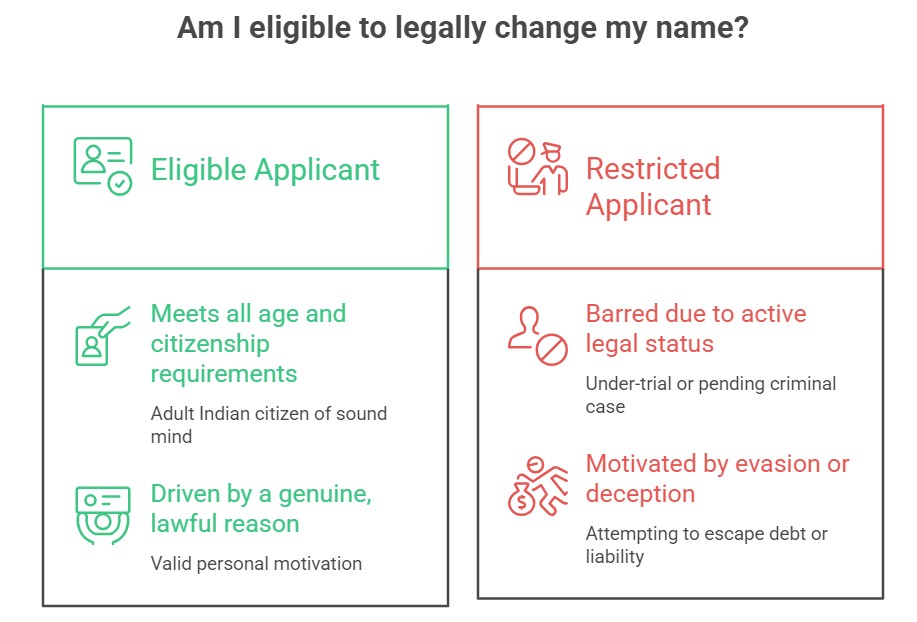
You generally cannot if:
- You have a pending or under-trial criminal case. A name change is usually barred until you’re acquitted, the case is concluded, or a court specifically permits it.
- The change is meant to escape a debt, a court case, or criminal liability.
- You are trying to impersonate someone or mislead the public.
What Names Are Not Allowed in India: The Complete Step-by-Step Guide (2026)
The law is generous about what you can call yourself, but a request will be refused if the new name:
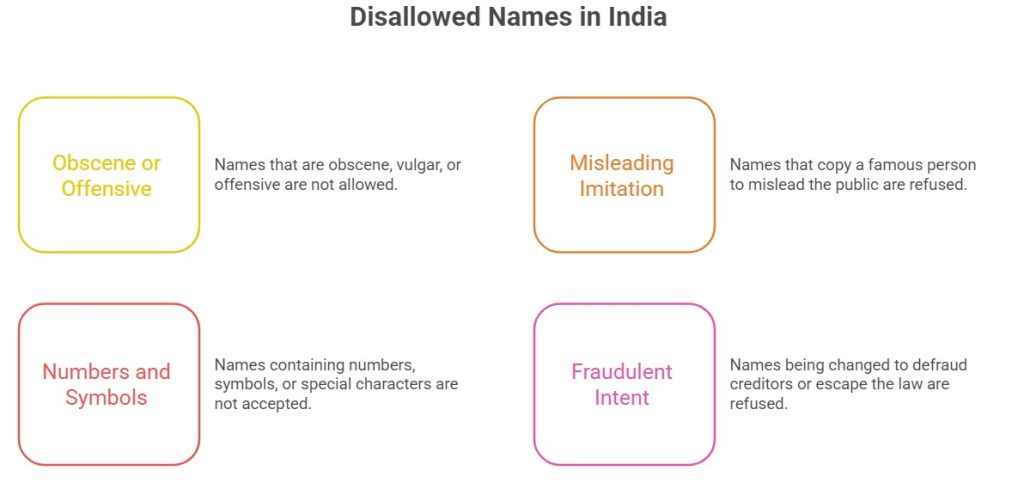
- Is obscene, vulgar, or offensive.
- Copies a famous person in a way meant to mislead the public.
- Contains numbers, symbols, or special characters such as @ or # — under current standards these aren’t accepted.
- Is being changed to defraud creditors or escape the law.
Genuine reasons get approved. Deceptive ones don’t.
The 3-Step Name Change Process in India: The Complete Step-by-Step Guide (2026)
The procedure is standardised across the country, with only minor variations by state.
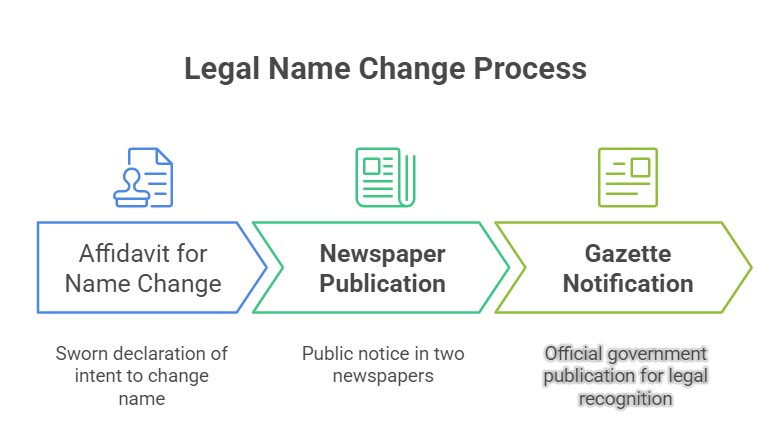
Step 1: Make the Affidavit
You start with a sworn affidavit on non-judicial stamp paper (usually ₹10 to ₹100, depending on your state; many states now prefer a digital e-stamp). It states your old name, new name, address, your father’s or husband’s name, and the reason for the change. It’s signed before a notary. This is where most rejections begin, so check that every spelling matches your ID exactly.
Step 2: Publish the Newspaper Advertisement
Next, publish a short name-change notice in two newspapers — one English and one in your state’s regional language. The notice carries your old name, new name, and address, worded to match the affidavit exactly. Keep the full original newspaper page, not a cut-out.
Step 3: Gazette Notification
This is the step that makes your new name official across India: The Complete Step-by-Step Guide (2026). You send your file to the Controller of Publications, Department of Publication, Civil Lines, Delhi-110054 — by post, courier, or in person. The file includes your affidavit, the original newspaper page, a filled proforma signed by two witnesses, a CD with the soft copy, ID proof, two photographs, and your BharatKosh fee receipt.
Once verified, your notice is published in the Gazette of India: The Complete Step-by-Step Guide (2026) (Part IV). You can then download the e-gazette copy from egazette.gov.in. Print several copies — you’ll need them for every document you update.
Do You Really Need All Three Steps?
Honestly, it depends on what you’re updating, and most pages won’t tell you this. For full nationwide recognition — a passport, PAN, or any government record — yes, the gazette is what counts, so do all three steps. For some smaller private updates, a notarised affidavit and newspaper ad alone are sometimes accepted, but you’re relying on each office’s discretion, and many now ask for the gazette anyway. The safe rule: if your name appears on a passport or a government record, do the full process.
Central Gazette vs State Gazette: Which One You Need
- Central Gazette (Gazette of India: The Complete Step-by-Step Guide (2026)): published by the Government of India: The Complete Step-by-Step Guide (2026), valid across the whole country. Needed for passport, PAN, and any all-India: The Complete Step-by-Step Guide (2026) use.
- State Gazette: published by a state government, valid mainly within that state. Often faster and cheaper, and some states allow online filing.
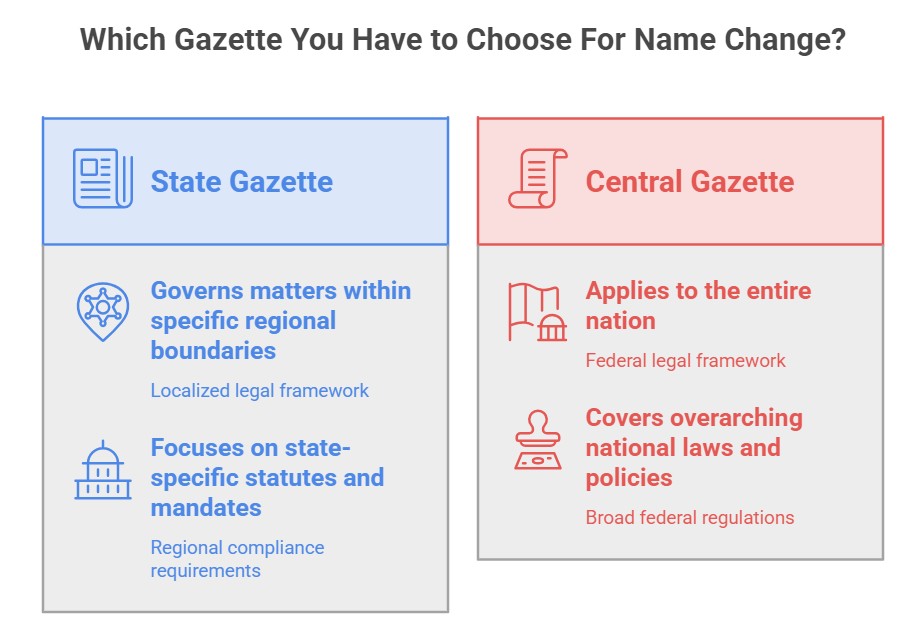
For most people who want their new name accepted everywhere — especially for a passport — the Central Gazette is the safer choice.
Which Affidavit You Actually Need (by Reason)
The affidavit type depends on your situation, and using the wrong one is a common cause of rejection:
- Notary affidavit — fine for most ordinary changes (marriage, personal, numerology).
- SDM affidavit — often needed for a complete change of name or surname.
- Executive Magistrate affidavit — required for a religion change, with a certificate from the religious institution.
- Deed of change of name — the route for central government employees, who may also need a departmental NOC.
If you live abroad, your affidavit or deed must be attested by the Embassy or High Commission.
Name Change Process by Reason
The core steps are the same, but the paperwork shifts with your reason.
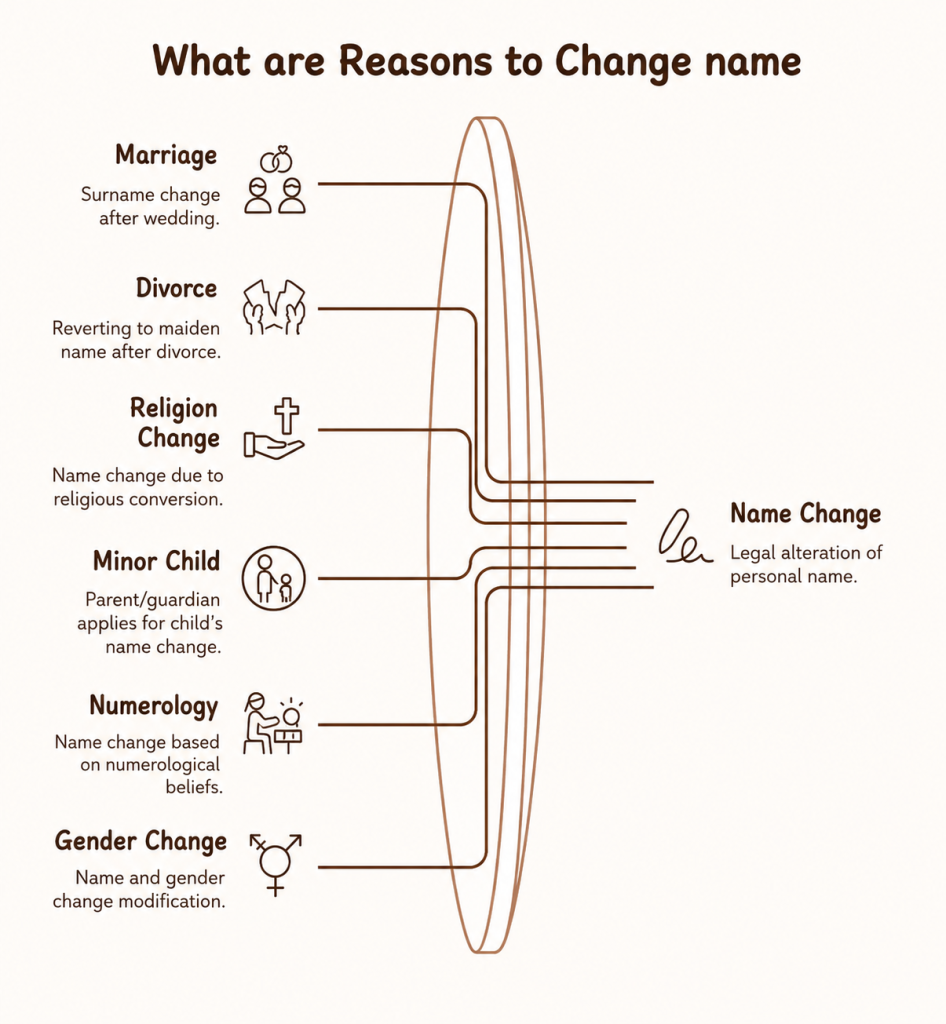
| Reason | What’s different |
| After marriage | Surname change; notice mentions father’s and husband’s names; attach marriage certificate. |
| After divorce | Reverting to maiden name; the divorce decree supports the change. |
| Religion change | Executive Magistrate affidavit + religious-institution certificate; some states need a prior declaration to the District Magistrate. |
| Minor child | A parent/guardian applies. The father is often the applicant; the mother can apply with a custody order, or if the father has died (death certificate). A dispute between parents may need a court order. |
| Numerology / personal | Standard notary affidavit; state the reason clearly. |
| Gender change | Combined name-and-gender notification. The law is in transition in 2026, so check the current rules. |
| Government employee | Deed of change of name under the MHA route; may need a departmental NOC. |
| NRI / abroad | Affidavit attested by the Embassy; higher gazette fee. |
Real 2026 Fees + How to Spot Overcharging
These are the real government charges, paid directly on BharatKosh — not to any agent.
| Item | Typical cost |
| Stamp paper + notary | ₹200 – ₹500 |
| Newspaper ad (two papers) | ₹500 – ₹2,500 |
| Gazette fee (adult) | ~₹1,100 |
| Gazette fee (minor) | ~₹1,700 |
| Total, doing it yourself | ₹3,000 – ₹6,000 |
| Watch for overcharging Government fees change, so confirm the current amount on BharatKosh. Be wary of agents who quote a ‘government fee’ of ₹5,000–₹10,000 and pocket the difference, or who promise a ‘one-day gazette’ — no official fast-track exists. Pay the gazette fee yourself, keep the receipt, and get any helper’s service charge in writing, separate from the government fee. | |
How Long Does It Take to Change Name in India: The Complete Step-by-Step Guide (2026)?
A clean Central Gazette filing usually publishes in about four to six weeks (the department officially allows up to eight). The affidavit and newspaper steps take a few days each; the gazette is the slow leg. Updating each document afterwards adds one to four weeks per document.
After the Gazette: Update Everything in the Right Order in India: The Complete Step-by-Step Guide (2026) and in Our Country
The gazette is the start of the updating phase, not the end. Publishing it doesn’t change anything else automatically — you update each record yourself. Do them in this order, because most services check against Aadhaar:
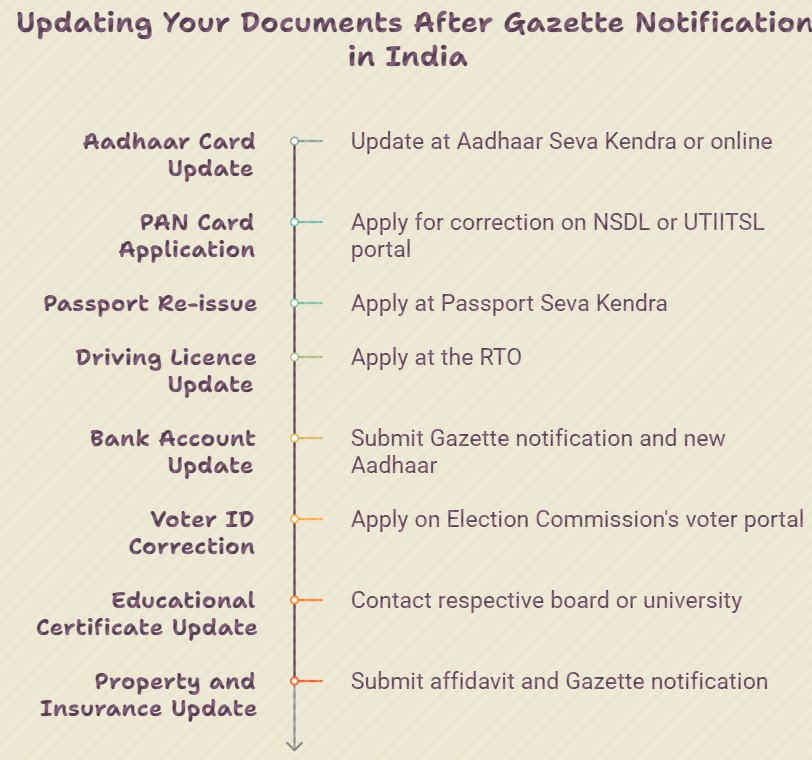
- Aadhaar — first, via myAadhaar or an Aadhaar Seva Kendra.
- PAN — through Protean (formerly NSDL) or UTIITSL. From April 2026, PAN corrections use Form CR-01 and must match Aadhaar exactly, so fix Aadhaar first.
- Passport — re-issue on Passport Seva.
- Voter ID — Form 8 on the Voters’ Service Portal.
- Driving licence — at the RTO or Parivahan Sarathi portal.
- Bank, EPF, insurance, and education records — with the gazette and updated Aadhaar.
| Good to know Your old documents stay valid after a name change, as long as you can show the gazette notification linking the old and new names. You don’t lose anything by changing your name — you just add the gazette as the bridge. |
Common Mistakes That Cause Rejection in India: The Complete Step-by-Step Guide (2026)
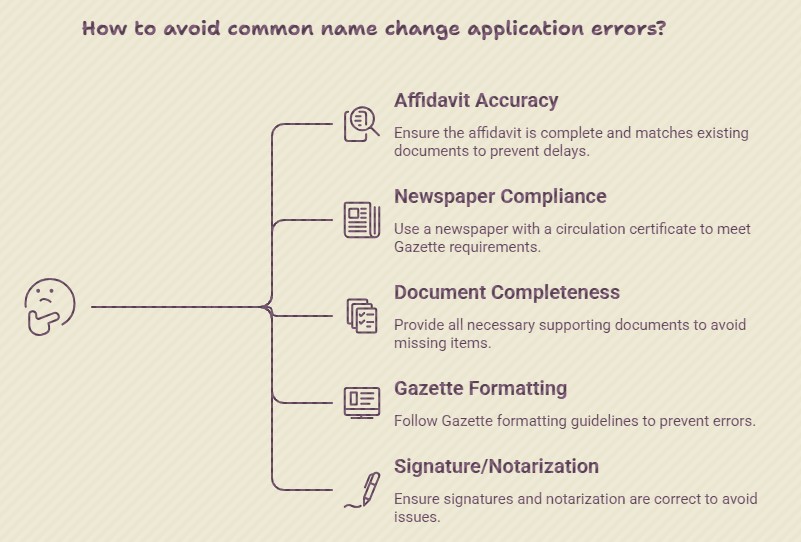
- The name spelled differently across the affidavit, the ad, and the proforma.
- A small ad clipping sent instead of the full original newspaper page.
- A missing or wrong-format CD (the Central Gazette needs the text in .docx).
- The wrong affidavit type — a notary affidavit for a religion change.
- A missing BharatKosh receipt, or paying under the wrong purpose.
Should You Do It Yourself or Use a Service?

If your case is simple and you have the time, you can do it yourself for the cost of the affidavit, ad, and gazette fee. If your case has any wrinkle — a minor, a religion or gender change, an NRI filing, or mismatched records — or you simply can’t spare the hours, a trustworthy service earns its fee by getting a clean, first-time acceptance. Just make sure you’re paying for genuine help, not an inflated fee.
Frequently Asked Questions
How do I change my name legally in India: The Complete Step-by-Step Guide (2026)?
Complete three steps: a notarised affidavit, a newspaper advertisement in two papers, and a Gazette of India: The Complete Step-by-Step Guide (2026) notification. Once published, your new name is legally recognised across the country.
Is the name change process the same in every state?
The core three steps are the same nationwide. Only the regional newspaper language and, if you use a State Gazette, the state’s own office and fee vary.
Do I need to go to Delhi for the gazette?
No. You can file the Central Gazette from any city by post or courier and pay the fee online. Visiting in person is optional.
Who cannot change their name in India: The Complete Step-by-Step Guide (2026)?
Anyone with a pending or under-trial criminal case (until acquitted, concluded, or with court permission), and anyone trying to escape a debt, a court case, or to mislead the public.
Is a gazette notification mandatory in India: The Complete Step-by-Step Guide (2026)?
For full nationwide recognition — passport, PAN, and government records — yes. For some smaller private updates an affidavit and newspaper ad alone are sometimes accepted.
How much does the name change process cost in India: The Complete Step-by-Step Guide (2026)?
Doing it yourself, about ₹3,000 to ₹6,000 in total, including the affidavit, newspaper ads, and the gazette fee of roughly ₹1,100 for adults.
How long does it take?
A clean gazette filing usually publishes in four to six weeks. Updating each document afterwards adds more time.
Can I change my name online in India: The Complete Step-by-Step Guide (2026)?
Partly. The affidavit, newspaper ad, and gazette fee can be handled online, and some states allow online gazette filing, but the core submission is still largely offline.
Do I need a lawyer to change my name?
No. It’s an administrative process, not a court case. A professional only helps with accurate paperwork, which is optional.
Which affidavit do I need?
A notary affidavit suits most cases. A full name change may need an SDM affidavit, and a religion change needs an Executive Magistrate affidavit.
What documents do I need?
A notarised affidavit, government ID proof, address proof, the original newspaper pages, a witness-signed proforma, a CD with the soft copy, two photos, and the BharatKosh receipt.
Are my old documents still valid after a name change?
Yes. Old certificates and IDs remain valid as long as you present them with your gazette notification, which links your old and new names.
Which document should I update first after the gazette?
Aadhaar. Most services check against it, and from April 2026 your PAN must match Aadhaar exactly.
Can I change my name more than once?
Yes. There’s no legal limit, provided you complete the full process each time and have a genuine reason. Repeat changes may draw more scrutiny.
What names are not allowed?
Obscene or offensive names, names that impersonate famous people to mislead, names with numbers or special characters, and changes meant to escape debt or a court case.
Is there a fast-track or same-day gazette?
No. There’s no official expedited service. Anyone promising a guaranteed one-day gazette for extra money isn’t being truthful.
Conclusion
The name change process in India: The Complete Step-by-Step Guide (2026) comes down to three steps — affidavit, newspaper ad, gazette — and the right to do it belongs to every citizen under the Constitution. The process is simple; the details are what catch people out. Use the correct affidavit for your reason, keep every spelling identical, make sure you’re eligible, pay only the real government fee, and remember the gazette is the start of updating your documents, not the finish line. Get those right and your new name will hold up everywhere it matters.
Read our Other Article
Name Change Process in India: The Complete Step-by-Step Guide (2026): The Complete Step-by-Step Guide, India: The Complete Step-by-Step Guide (2026) Gazette Office: Address, Work, Fees & How to Use It, Change of Name in India: The Complete Step-by-Step Guide (2026), Name Change Advocate in India: The Complete Step-by-Step Guide (2026): Do You Need One? , Name Change Consultants in India: The Complete Step-by-Step Guide (2026), Name Change Agent in India: The Complete Step-by-Step Guide (2026), Name Change in Education Certificate in India: The Complete Step-by-Step Guide (2026): Complete Legal Guide, Name Change Service in India: The Complete Step-by-Step Guide (2026): Process, Cost & Gazette Guide
