Change of Name in India: The Complete Guide Step By Step For India Citizen
A change of name in India is a legal process that lets you officially update your name in government and personal records. People do it for many reasons — getting married, divorce, fixing a spelling mistake, religious change, or simply wanting a fresh start with a new name. While it may sound complicated, the change of name process mainly involves three steps: signing an affidavit, publishing a notice in the newspaper, and getting your new name printed in the Central Gazette. Once these steps are done, you can update your name across important documents like Aadhaar, PAN, passport, and bank records. With the right guidance, changing your name can be quick, simple, and completely stress-free in India.
Most people in India don’t get stuck because of the law. They get stuck on the small things — which affidavit they really need, what the actual government fee is (and who is charging them extra), and the part that almost no one explains: what to do after the Gazette is published. That is when the real work begins, because you have to update your name on each document one by one. This guide explains all of it in plain and easy words, from start to finish.

Can You Legally Change Your Name in India?
Yes. There’s no single “Name Change Act,” but the right flows from the freedom of expression guaranteed by the Constitution, and the process is governed by the Department of Publication’s guidelines. Any citizen of sound mind who is 18 or older can do it. For a child under 18, a parent or legal guardian applies on their behalf.
A few conditions apply. You need a valid India ID proof in your existing name, a genuine reason for the change, and no intention to dodge a debt, a court case, or a criminal liability by switching identities. Beyond that, the reason can be almost anything — marriage, divorce, adoption, religion, numerology, a spelling fix, or simply that you don’t like your name.
WHY NAME CHANGE IS REQUIRED ?
- Error in birth certificate
- Errors in school certificates
- Post marriage by women
- After divorce for women
- Spelling errors.
- For adoptions
- If religion is changed
- For other official purposes
Need to legally change your name for marriage, astrological, passport, personal or professional reasons? We make this complicated matter simple! With us your entire process for name change is very transparent and choosing us provides the following benefits:
The 3-Step Process to Change Your Name in India
Here are the three steps in order. They’re the same across every state, with only minor local variations.
Step 1: The Affidavit — and Which Type You Actually Need
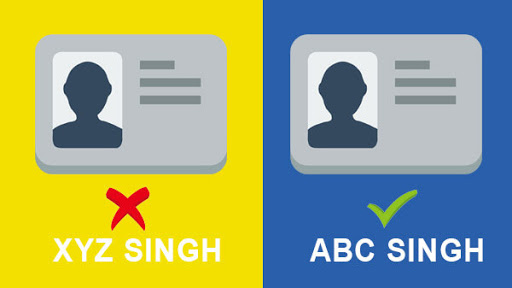
You start by swearing an affidavit on non-judicial stamp paper (usually ₹10 to ₹100, depending on your state). It states your current name, your new name, your address, your father’s or husband’s name, and the reason for the change. This is where most guides stop — but the type of affidavit depends on your situation, and getting this wrong is a common cause of rejection:
- Notary affidavit — fine for most ordinary name changes (marriage, personal, numerology). Attested by a Notary Public or Oaths Commissioner.
- SDM affidavit — often needed for a complete change of name or surname, where a Sub-Divisional Magistrate attests it rather than a notary.
- Executive Magistrate affidavit — required for a religion change. Because of anti-conversion provisions in several states, a plain notary affidavit isn’t accepted, and you’ll also need a certificate from the relevant religious institution.
- Deed of change of name — the route for central government employees, who follow the Ministry of Home Affairs office memorandum rather than the ordinary affidavit path.
If you live abroad, your affidavit or deed must be attested by the Indian Embassy or High Commission in your country.
Step 2: Newspaper Publication
Next you publish a short name-change notice in the newspaper. One national or regional daily is the baseline; if you hold a passport or plan to apply for one, publish in two newspapers — ideally one English and one in your regional language. The notice carries your old name, new name, address, and the date of the affidavit.
| Keep the whole page Don’t snip out just the small advert. The Gazette department wants the full original newspaper page on which your notice appeared, and a cutting older than one year is not accepted. |
Step 3: Gazette Notification
This is the step that makes your new name official across the country. You assemble the file and send it to the Controller of Publications, Department of Publication, Civil Lines, Delhi-110054 — by Speed Post, courier, or in person. The file includes:
- Your notarised affidavit (or deed)
- The original newspaper page
- The filled proforma (computer-typed, signed by you and two witnesses, in duplicate)
- A CD with the soft copy of the proforma in MS Word — without the witness column, and with your old name typed where the signature would go
- A certificate confirming the hard copy and soft copy match
- Self-attested copy of your government ID proof
- Two passport-size photographs
- Your BharatKosh fee receipt
Once the department verifies everything, your notice is published in the Gazette of India (commonly Part III, Section 4; a combined name-and-gender change goes in Part IV). You can then download the e-Gazette copy from the official portal, and a copy is also posted to you. Print several copies — you’ll need them for every document you update later.
Do You Really Need All Three Steps?
Honestly? It depends on what you’re trying to update, and this is the bit most pages won’t tell you.
For full, nationwide legal recognition — a passport, PAN, central records, or anything official — yes, the Gazette notification is what counts, and you want all three steps. For some smaller private updates a notarised affidavit and a newspaper ad alone are sometimes accepted, but you’re relying on each institution’s discretion, and many now ask for the Gazette anyway. For central government employees, the deed route under the Home Ministry memorandum is mandatory. The safe rule: if your name appears on a passport or a government record, do the full process. Anything less and you risk having to redo it.
Name Change vs Name Correction vs Surname Change in India
People use these interchangeably, but they aren’t the same, and mixing them up can get a file bounced.
- Name change: adopting a genuinely different name from the one on your records.
- Name correction: fixing a spelling or clerical error so your documents match. The wording of the affidavit differs from a full change.
- Surname change: common after marriage or divorce; you keep your first name and alter the surname. After marriage, the notice should mention both your father’s and husband’s names.
Real Government Fees for Change of Name in India Citizen
This is where people get fleeced, so here are the actual government charges. These are paid directly to the Department of Publication through BharatKosh — not to any agent.
| Applicant type | Govt. Gazette fee | Notes |
| Adult (general public) | ~₹1,100 | Standard single name change |
| Minor (under 18) | ~₹1,700 | Parent/guardian is the applicant |
| Government employee | ~₹1,100 | Uses the deed route; same fee as adult |
| NRI / Indian abroad | ~₹7,500 | Higher, due to extra verification |
| Each alias / extra name | ~₹250 extra | Added on top of the base fee |
| Verify before you pay Government fees change from time to time. Confirm the current amount on the BharatKosh portal before paying. The figures above reflect the rates commonly cited in 2026. | ||
On top of the Gazette fee, budget a little for the stamp paper and notary (₹200–₹500 if you do it yourself) and the newspaper advert (₹500–₹2,500). All in, a do-it-yourself name change typically lands between ₹3,000 and ₹6,000.
How to Pay the Gazette Fee on BharatKosh (Step by Step)
- Go to bharatkosh.gov.in and choose the option for non-registered users.
- Under depositor category, select “Individual.”
- In the Purpose section, choose the Ministry of Housing & Urban Affairs, then “Sale of Gazette (PAO Printing, New Delhi).”
- Set the PAO and DDO to the Controller of Publications, New Delhi, when prompted.
- Enter the fee amount for your category (adult, minor, or NRI), complete the captcha, and add it.
- Fill in your depositor details, then pay by card, UPI, or net banking.
- Download and print the receipt immediately — it’s the only proof of payment the department accepts, and it goes into your file.
Documents Required For Change of Name in India
Keep these ready before you begin. Having the full set in one go is the difference between first-time acceptance and a bounced file.
- Notarised affidavit (or deed / SDM / Executive Magistrate affidavit, as your case needs)
- Government photo ID proof in your current name (Aadhaar, PAN, passport, voter ID, or driving licence)
- Address proof
- Original newspaper page carrying your name-change notice
- Proforma signed by you and two witnesses, in duplicate, computer-typed
- CD with the soft copy of the proforma in MS Word
- Certificate confirming hard copy and soft copy match
- Two passport-size photographs
- BharatKosh fee receipt
- Supporting documents for your reason (marriage certificate, divorce decree, adoption papers, religious-institution certificate, etc.)
| Heads-up on ID proof The Gazette department accepts only government ID (Aadhaar, PAN, driving licence and the like) as proof of your old name. Bank passbooks, LIC papers, and school documents are not accepted for this. |
Change of Name for Every Situation in India
The core process is the same, but the paperwork and wording shift with your reason.
| Situation | What’s different |
| After marriage | Surname change; notice mentions both father’s and husband’s names; attach marriage certificate. |
| After divorce | Reverting to maiden surname; the divorce decree supports the change. |
| Religion change | Needs an Executive Magistrate affidavit (not notary) plus a certificate from the religious institution. |
| Adoption | Uses a separate proforma; needs the adoption document and ID of biological and adoptive parents. |
| Gender change | Combined name-and-gender notification, published in Part IV; document-heavy and sensitive. |
| Numerology / personal | Standard notary affidavit; just state the reason clearly. |
| Government employee | Deed of change of name under the MHA office memorandum; may need a departmental NOC. |
| NRI / abroad | Affidavit/deed attested by the Indian Embassy or High Commission; higher Gazette fee. |
| Minor child | Parent/guardian is the applicant; both parents usually sign; agents can’t file on a minor’s behalf. |
Special Rules for a Minor’s Name Change in India
Changing a child’s name follows the same three steps, but with a few important differences. A parent or legal guardian is the applicant — the child can’t sign. Both parents are usually expected to sign the documents; if one parent is unavailable, a custody order or death certificate may be needed. The newspaper notice must include the word “minor” and the child’s age, along with the father’s name. And note: agents and advocates aren’t permitted to submit a minor’s application — the guardian has to send it directly or appear in person.
How Long Does It Take for Change of Name in India?
The Department of Publication officially allows up to eight weeks, but in practice the Gazette is usually published within about four to six weeks of a clean submission. The affidavit and newspaper steps take only a few days each; the Gazette is the slow leg. After publication, updating each of your documents adds more time — anywhere from one to four weeks per document. Be wary of anyone promising a guaranteed 24-hour or “expedited” Gazette: there is no official fast-track service.
After the Gazette: How to Update Your Name on Every Document in India and in our Country
This is the part most guides skip, and it’s where the real work sits. Publishing the Gazette doesn’t automatically change anything else — you update each record yourself, using your Gazette copy as proof. Here’s the practical order and where to do each.
| Document | Where & how to update |
| Aadhaar | Update via a UIDAI enrolment/update centre or the myAadhaar portal, with your Gazette copy as proof. Do this first — most other updates lean on Aadhaar. |
| PAN card | Apply for a correction through the Protean (NSDL) or UTIITSL portal, attaching the Gazette and updated Aadhaar. |
| Passport | Book an appointment on Passport Seva for re-issue with the new name; the Gazette is the key document and two newspaper ads are expected. |
| Voter ID | Update through the Voters’ Service Portal (Form 8). |
| Driving licence | Apply at the RTO or via the Parivahan Sarathi portal. |
| Bank accounts & KYC | Submit the Gazette and updated ID at your branch to refresh KYC across accounts, cards, and investments. |
| PF / UAN | Update with your employer and through the EPFO member portal so it matches your Aadhaar. |
| Insurance / LIC | Submit the Gazette to your insurer to update policy records. |
| Educational certificates | Apply to your board or university; some accept the Gazette, others have their own process. |
| Property & legal papers | Update deeds, wills, and registrations as needed, keeping the Gazette on file. |
A practical tip: update Aadhaar first, then PAN, then everything else — because so many services verify against Aadhaar. Keep ten to fifteen printed Gazette copies; you’ll get through them faster than you expect.
What Names Are Not Allowed
Indian law is generous about what you can call yourself, but there are limits. A request will be refused if the new name is obscene or offensive, if it appears designed to impersonate a famous person or mislead the public, or if the change looks like an attempt to escape debt, a court case, or criminal liability. Genuine reasons get approved; deceptive ones don’t.
Common Reasons Applications Get Rejected (and How to Avoid Them)
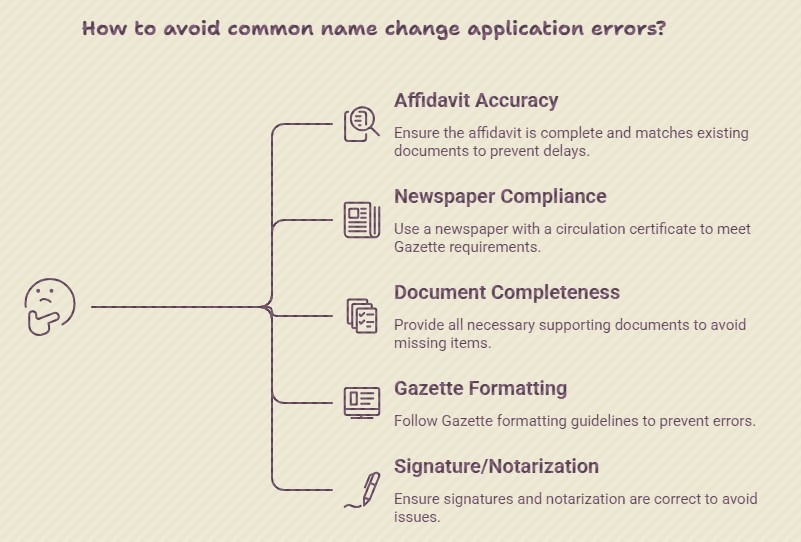
- The name is spelled differently across the affidavit, the newspaper ad, and the proforma. Check every spelling several times.
- The CD is missing, in the wrong format, or includes the witness column it shouldn’t.
- A small clipped advert is sent instead of the full original newspaper page.
- The wrong affidavit type is used — a notary affidavit for a religion change, for instance.
- Non-government ID is submitted as proof of the old name.
- The BharatKosh receipt is missing or paid under the wrong purpose.
Real Fees vs Agent Scams: Don’t Get Overcharged
Some name change agents quote “government fees” of ₹5,000 or ₹10,000 and pocket the difference. The real Gazette fee is roughly ₹1,100 for adults, ₹1,700 for minors, and ₹7,500 for NRIs — nothing more. Others sell “expedited processing” for an extra charge; no such official service exists. Protect yourself with three habits: insist the Gazette fee is paid directly through BharatKosh in your name, ask for the official receipt, and get the professional’s own service fee in writing, separate from the government charge. Paying for help with the paperwork is reasonable. Paying a marked-up “government fee” is not.
Should You Do It Yourself or Use a Service?
If your case is simple, you have time, and you’re comfortable with forms and a trip to the post office or ready to visit Gazette office, you can do this yourself for the cost of the affidavit, the ad, and the Gazette fee. If your case has any wrinkle — a minor, a religion or gender change, an NRI filing, mismatched records, or you simply can’t spare the hours — a trustworthy service is worth it, because the value is a clean, first-time acceptance and no repeat visits. Just make sure you’re paying for genuine help, not an inflated fee.
Faq For Change of Name in India
1. How do I change my name legally in India?
You complete three steps: sign a notarised affidavit stating your old and new name, publish a notice in the newspaper, and get it notified in the Gazette of India. Once published, your new name is legally recognised everywhere.
2. Is a Gazette notification mandatory for a name change in India?
For full nationwide recognition — passport, PAN, and government records — yes. The Gazette notification is the document that makes your new name official across the country.
3. What is the government fee for change of name in India in 2026?
The Gazette fee is roughly ₹1,100 for adults, ₹1,700 for minors, and ₹7,500 for NRIs, paid through the BharatKosh portal. Always confirm the current amount on the portal before paying.
4. How long does it take to change a name in India?
A clean Gazette submission is usually published in about four to six weeks. The department officially allows up to eight weeks. Updating each document afterwards adds more time.
5. Can I change my name online in India?
Partly. You can create the affidavit, place the newspaper ad, and pay the Gazette fee online, and some states allow online Gazette applications. The core submission to the Department of Publication is still largely offline.
6. What documents do I need to change my name?
A notarised affidavit, government ID proof, address proof, the original newspaper page, a witness-signed proforma, a CD with the soft copy, two photographs, and your BharatKosh receipt, plus any documents specific to your reason.
7. Do I need a lawyer to change my name in India?
No. A standard name change is an administrative process, not a court case. A professional only helps you draft the documents correctly and avoid rejection, which is optional.
8. Which affidavit do I need for a name change?
A notary affidavit suits most cases. A complete name or surname change may need an SDM affidavit, a religion change needs an Executive Magistrate affidavit, and government employees use a deed of change of name.
9. How do I update my Aadhaar after a name change?
Visit a UIDAI update centre or use the myAadhaar portal and submit your Gazette copy as proof. Update Aadhaar first, since many other services verify against it.
10. How do I change my name in PAN after the Gazette?
Apply for a PAN correction through the Protean (NSDL) or UTIITSL portal, attaching the Gazette notification and your updated Aadhaar.
11. Can I change my child’s name in India?
Yes. A parent or guardian applies on the child’s behalf. Both parents usually sign, the notice must mention the word “minor” and the child’s age, and agents can’t file for a minor.
12. Can I change my name after marriage?
Yes. A surname change after marriage uses the same three steps. The newspaper notice should mention both your father’s and husband’s names, and you attach your marriage certificate.
13. What is the total cost of changing a name in India?
Doing it yourself, the total usually comes to between ₹3,000 and ₹6,000, covering stamp paper and notary, the newspaper ad, and the Gazette fee.
14. Can I change my name more than once?
Yes. There’s no limit, provided you complete the full affidavit, newspaper, and Gazette process each time and have a genuine reason.
15. What names are not allowed in India?
Obscene or offensive names, names that impersonate famous people to mislead the public, and changes made to escape debt, a court case, or criminal liability will be refused.
16. Is there a fast-track or same-day Gazette service?
No. There is no official expedited service. Anyone promising a guaranteed 24-hour Gazette for a standard case in exchange for extra money is not being truthful.
Conclusion
A change of name in India comes down to three steps — affidavit, newspaper ad, Gazette notification — and the right to do it belongs to every citizen. The process itself is simple; the details are what catch people out. Use the correct affidavit for your reason, keep every spelling identical across your papers, pay only the real government fee through BharatKosh, and remember that publishing the Gazette is the start of the document-updating phase, not the finish line.
Get those things right and your new name will hold up everywhere it matters — your passport, your PAN, your bank, and the rest. Take it step by step, keep plenty of Gazette copies, and don’t let anyone sell you a fast-track that doesn’t exist.
| Want your name change done right the first time? Namechange.in handles the complete change-of-name process across India — affidavit, newspaper publication, and Gazette filing — at the real government fee with no inflated charges. Tell us your reason and we’ll tell you exactly what it needs, what it costs, and how long it’ll take. [Insert contact number / WhatsApp link / “Get a Free Consultation” button here.] |
Written & Reviewed By: Vipin Chauhan (B.Tech, LL.B., Diploma in Cyber Cell – Pursuing)
With expertise spanning technology, legal documentation, and cybersecurity, Vipin Chauhan specializes in simplifying complex government and legal procedures into practical, easy-to-understand guides. This article has been carefully reviewed for accuracy and relevance
Disclaimer:
The information provided in this guide is intended for general informational purposes only and should not be considered legal advice. Government procedures, documentation requirements, fees, and processing timelines may vary across states and are subject to change without prior notice. Applicants are advised to verify the latest requirements through the official government portal (deptpub.gov.in) or consult a qualified legal professional before proceeding with any application.